Port of Piraeus
📍 Athens, Greece · 🕰 Present Day
Leaving Athens
A network is just nodes and paths — the same whether it's roads or cables.
Overview
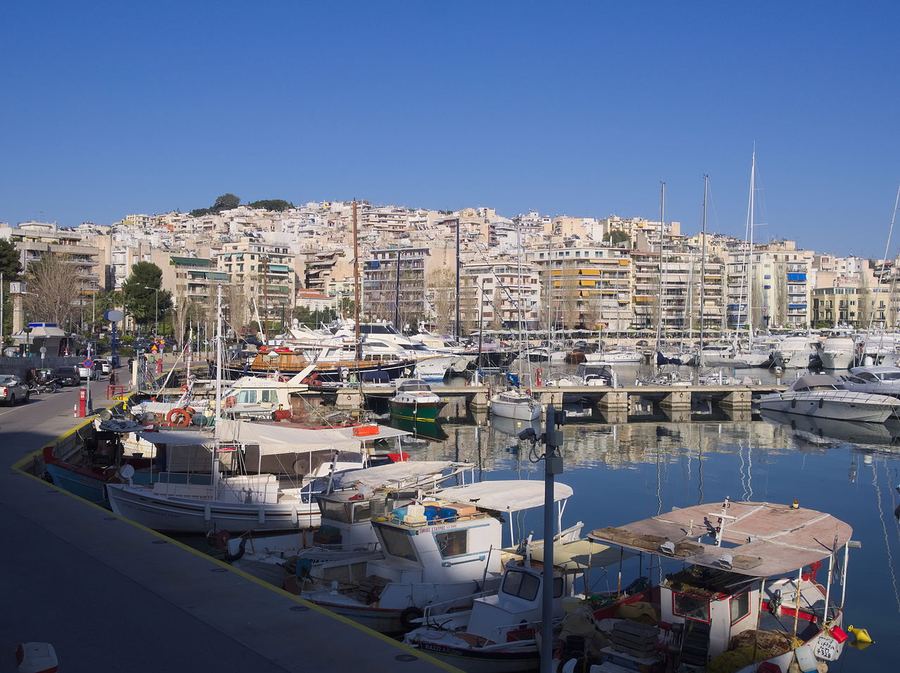
You're standing at the Port of Piraeus, the ancient harbor of Athens. Before you can travel anywhere, you need to understand the network of roads, ships, and planes that connect the world. A computer network works exactly the same way: devices (nodes) connected by paths (links), each able to send information to any other.
The ancient Greeks built road networks to move armies and trade goods; we build computer networks to move data — and in both cases the principles are identical:
- Every node needs an address.
- Every path has a direction.
- Information travels from source to destination by hopping through intermediate points.
Your mission begins here. Read the port map, understand how the network of routes connects Athens to the world, and find your path west — toward Santa Cruz, California.
Concept Flow
How the ideas above connect — follow the steps left to right.
▸ What the lab will have you prove
4 steps- 1STEP 1Port Map
- 2STEP 2Route Traced
- 3STEP 3Rerouted
- 4STEP 4Departure Confirmed
Technical Deep-Dive
How Computer Networks Are Built
A network is a collection of devices (computers, phones, routers) connected by physical or wireless links. Each device is a node. Data travels as electrical signals over cables, or as radio waves over WiFi. The internet is just a global network of networks — millions of smaller networks all interconnected.
The shape of a network — how its devices are wired together — is called its topology:
- In a 'star' shape, every device connects through one central point (think of your home WiFi router).
- In a 'mesh' shape, devices connect to many others directly.
The internet is mesh-like on purpose: if one path breaks, data just takes another, so there's no single point of failure.
▸ Checking your network connections on Linux/Mac
# See all network interfaces on your device
ip addr show          # Linux
ifconfig              # Mac/older Linux

# See which devices are on your local network
arp -a

# Trace the path data takes to reach a destination
traceroute google.com
Real-World Incident
The 2021 Facebook Outage — When a Network Loses Its Map
Impact
3.5 billion users offline for 6 hours; $60M+ revenue loss
On October 4, 2021, Facebook's engineers made a routine configuration change that accidentally removed all the routing information telling the internet how to find Facebook's servers. Every road on their network map was erased simultaneously.
No one could reach Facebook, Instagram, or WhatsApp. Even Facebook's own engineers couldn't log in remotely to fix the problem — they had to physically drive to the data center and manually restore the routing tables. The network still existed; the map of how to traverse it was simply gone.
Timeline
Key Takeaways
A network is nodes (devices) connected by links (cables/WiFi)
The internet is a network of networks — no single owner
Routing tables are the 'map' — lose the map, lose the network
Every device needs an address to send and receive data
References
Ready for the challenge?
Choose how you want to clear this stage.